Mobile Price Rises in April 2027: What Each UK Network Is Adding
Last updated: 7 November 2026 | Next review due: 7 February 2027
SimSaver may earn a commission if you buy through links on this page. This never changes how we rank or describe a deal; see how we compare.
Key takeaways
- Most UK mobile contracts go up every spring by a fixed amount you agreed to when you signed. If you joined recently, expect about £1.80 to £2.50 a month on SIM-only and airtime plans; older contracts often rise less, and EE adds £4 on handset plans taken from 10 September 2024.
- A flat rise hurts cheap plans most. £2.50 is 25 per cent on a £10 plan and 8.3 per cent on a £30 plan, against CPI inflation of 3.5 per cent in the year to September 2026.
- If the rise was written into your contract in pounds and pence, you cannot leave free because of it. If it was not, or the provider adds more than it promised, it must give you at least 30 days' notice, and you can leave without an exit fee if you act within that window.
- Out of contract, you can switch any time. That is often where the biggest saving is, because the rise lands on top of a price that may already be too high.
- Some deals have no annual rise: iD Mobile SIM-only, Talkmobile, Tesco Mobile Clubcard deals during the minimum term, and the main social tariffs.
The short answer
Short answer
- Find your rise. It is in your Contract Summary, your provider's price page or the message it sent you.
- Add it up. Multiply the monthly rise by the months it will apply, for every line on the account.
- Check whether you can leave free. Only if the rise was not set out in your contract, or is bigger than stated.
- If you are out of contract, compare now and switch before April.
- If you are in contract and the rise was agreed, plan your switch for the end date, not before.
How mobile price rises work now
Since 17 January 2025, Ofcom has banned inflation-linked and percentage price rises in new phone and broadband contracts. Any rise during the contract has to be shown in pounds and pence at the point of sale, so you know in advance that £20 becomes £22.50 next April. Several networks switched early: EE and BT from April 2024, Three from September 2024 and Tesco Mobile from December 2024.
Rises are now predictable, but not necessarily small. An analysis of more than 47,000 tariffs, published by a consumer-advice site on 29 June 2026, found that about three-quarters would have cost less under the old inflation-linked system (findings described as provisional). Low-data plans fared worst, because a flat £2.50 is a big slice of a small bill.
The Government asked Ofcom in November 2025 for an interim review of the rules by spring 2026 and a full review in 2027. Ofcom confirmed in a freedom of information reply (22 July 2026) that it is reviewing the impact. The interim review was due by spring 2026, but we could not find it published by 7 November 2026, so the April 2027 rises go ahead under the current rules.
Older contracts on CPI plus 3.9 per cent
A few customers are still on the old formula until their minimum term ends. Tesco Mobile, for example, says non-Clubcard deals taken between 27 March 2023 and 16 December 2024 rise by the January CPI rate plus 3.9 per cent each April during the minimum term. Every 24-month deal from that period ends by December 2026, so only longer contracts still face a CPI-linked rise in April 2027. If yours has ended, you are out of contract and free to switch.
What each network is adding
These figures come from each provider's own price page, checked on 7 November 2026. Your amount depends on when you joined or last upgraded, so treat this as a guide and confirm the line in your own Contract Summary.
SimSaver may earn a commission on links here; this never changes how we rank.
| Provider | Monthly rise | When | Who it applies to |
|---|---|---|---|
| EE | £2.50 SIM-only and airtime; £4 handset plans | Each 31 March in the minimum term | SIM-only and airtime from 31 Jul 2025 (£1.50 if 10 Apr 2024 to 30 Jul 2025); handset plans from 10 Sep 2024 |
| BT Mobile | £2.50 SIM-only and handset plans | Each 31 March | Products bought from 10 Apr 2024 |
| O2 | £2.50 airtime plans; 75p data-only and smartwatch | April 2027 | Pay monthly airtime; device plan price unchanged |
| Vodafone | £2.50 airtime plans (£1.80 on contracts before 12 Nov 2025); SIM-only Basics £1.50 | Each 1 April | Pay monthly, SIM-only and mobile broadband; device plans, social tariffs and customers registered as financially vulnerable excluded |
| Three | £1.80 (up to 4GB), £1.90 (5GB to 99GB), £2.30 (100GB and unlimited) | Each 1 April | Contracts from 9 Nov 2025; device payments and add-ons excluded |
| Tesco Mobile | Clubcard deals: none in the minimum term. Other deals: an amount set for your tariff at sign-up | Each April | Clubcard deals whose term ends 1 Feb 2026 to 31 Jan 2027 get their first rise in April 2027, after the minimum term ends |
| iD Mobile | None on SIM-only or PAYG; £1.50 or £1.80 on phone plans | Each April | Phone plans: £1.50 if bought 15 Jan 2025 to 10 Mar 2026, £1.80 from 11 Mar 2026 |
| Talkmobile | None | Not applicable | All plans |
How we compare. We list each provider's own published rise, the month it applies and who it covers, in order of network size and then brand. We checked each price page on 7 November 2026; O2's page is titled for April 2027, while EE and BT show 2027 in worked examples and Vodafone and Three describe a rise "each year" under a heading dated April 2026. Provider pages and your own Contract Summary are the final authority. We do not rank by commission.
Notes on the table:
- EE's example shows a £25 SIM-only plan becoming £27.50 from 31 March 2026 and £30 from 31 March 2027. Once your EE minimum term ends, plan rises move to 1 March instead. EE says prices are frozen on its Mobile Basics social tariff and on pay as you go.
- O2's example shows a £30 airtime plan rising to £32.50 and a £9 data-only plan to £9.75 from April 2027, with the device plan unchanged.
- Vodafone says future pricing changes will follow Ofcom's guidance but has not published a separate 2027 figure on its price page, so check your own contract.
- Three's older contracts (8 September 2024 to 8 November 2025) carry smaller rises of £1 to £1.50, according to Three's price pages.
- Sky Mobile works differently. It does not set rises at sign-up; it announces them. A consumer-advice site reported that in 2026 most affected customers paid £1.50 more from 14 February (customers who joined from 6 November 2025 and social tariff customers were excluded) and could leave penalty-free within 30 days of being told. Sky had not announced a 2027 rise when we checked.
Out-of-bundle charges rise too
Calls to premium numbers, extra data and other charges outside your allowance can rise separately, and some still use percentages. EE and O2 say their out-of-bundle charges go up by 5 per cent; Vodafone's page links them to the January CPI rate plus 3.9 per cent; Three says its out-of-bundle charges are not affected. If you regularly go over your allowance, a bigger plan or a bill limit may save more than the rise costs.
How much will your bill actually go up?
Because rises are flat amounts, the percentage depends entirely on what you pay now.
| Monthly price before the rise | £2.50 rise as a percentage |
|---|---|
| £8 | 31.3% |
| £10 | 25.0% |
| £15 | 16.7% |
| £20 | 12.5% |
| £30 | 8.3% |
For comparison, the Office for National Statistics put CPI inflation at 3.5 per cent in the 12 months to September 2026, with prices in its communication category up 5.8 per cent. The next figure is due on 18 November 2026.
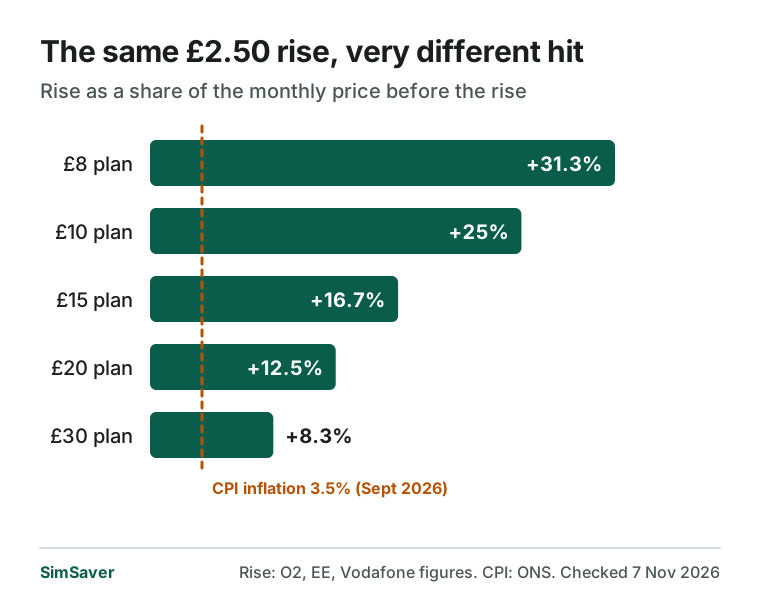
If you use little data on a cheap plan, a fixed rise costs you proportionally more, so a deal with no scheduled rise is worth comparing first.
Can you leave without paying an exit fee?
It depends on whether the rise was set out in your contract.
The rise was in your contract in pounds and pence. You agreed to it when you signed, so it does not give you a right to leave free. You can still leave, but you pay the normal early termination charge. Exit fees are usually based on the payments left on your term; our switching guide shows why paying one rarely saves money.
The rise was not in your contract, or it is bigger than stated. Ofcom says that if a provider raises prices beyond what you agreed, it must give you 30 days' notice and let you leave without penalty (statement of 30 October 2025). That statement followed O2's decision, reported by a consumer-advice site, to raise its April 2026 rise from the £1.80 it had told customers to £2.50 for people who joined before 23 October 2025. Ofcom said it was disappointed by the decision and wrote to the major networks reminding them to treat customers fairly.
The window runs from the notice, not from the first higher bill. According to the same report, O2's 2025 exit window ran 30 days from its message, so anyone who waited for the April bill had missed it. If you get a message about a change you did not sign up for, decide within days, not weeks.
You are out of contract. You do not need a reason. You can switch at any time with a PAC, and since 1 July 2019 your old provider cannot charge you for a notice period after the switch date.
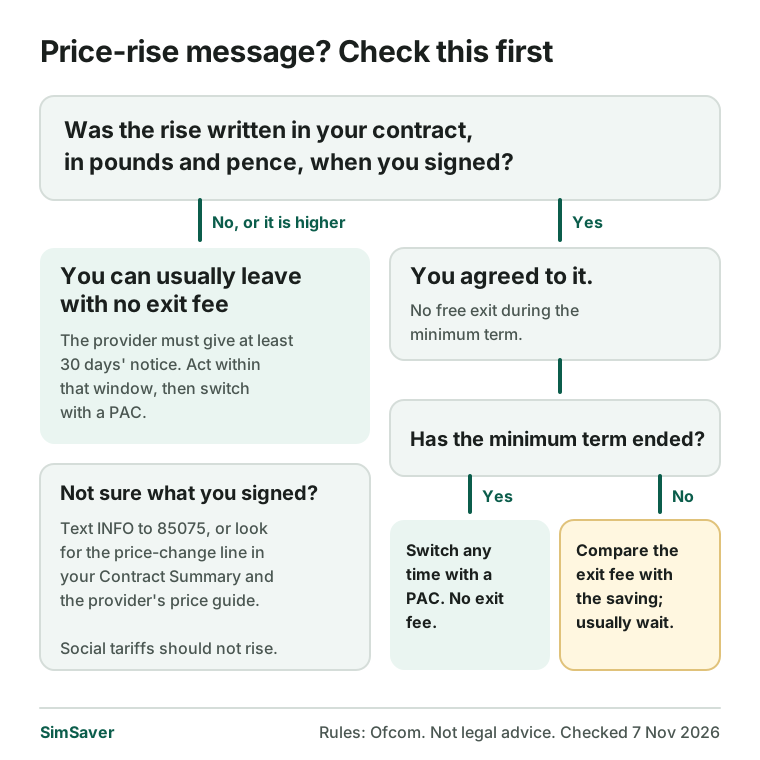
Not sure what you signed? Text INFO to 85075 for your contract end date, and look for the "price changes" line in your Contract Summary, the short summary providers must give you before you sign.
If you are out of contract
If your minimum term has ended, the April rise lands on top of a price that may already be too high, especially if you once had a phone bundled in. Ofcom's end-of-contract rules require providers to warn you 10 to 40 days before your contract ends and tell you about their best deals, then remind you every year you stay out of contract. That message is worth reading properly: it shows what you pay now against what the provider would charge a new customer.
EE moves out-of-contract rises to 1 March, ahead of the in-contract date. Whichever network you are on, switching before your provider's rise date means you will not pay that provider's rise. With a rolling plan you can switch again next year if something better appears.
Six ways to avoid or soften the rise
1. Switch before the rise date if you are free to. Out of contract, there is no reason to wait for April. The switch takes one text and about a working day.
2. Choose a deal with no scheduled annual rise. On their own pages, iD Mobile says its SIM-only and pay-as-you-go plans have no annual increase, Talkmobile says none of its plans have annual price rises, and Tesco Mobile freezes the basic price on Clubcard deals for the minimum term. Lebara's own page says its SIM-only plans have no mid-contract price rises. Do not assume a rolling plan is rise-free: on the big networks, out-of-contract and rolling plans usually still go up each spring (EE from 1 March). The difference is that you can leave on short notice when they do.
3. Right-size your plan before you compare. Ofcom's research found that 55 per cent of pay-monthly customers use 20 per cent or less of their allowance. A smaller plan with no scheduled rise is often better value than a big plan that is about to get £2.50 dearer. Our guide to cutting what you pay shows how to measure your real use.
4. Check whether you qualify for a social tariff. These are cheaper plans for people on benefits such as Universal Credit or Pension Credit, and Ofcom says their prices should not rise mid-contract. Examples include O2's Essential Plan (£10 for 10GB), VOXI For Now (£10, with unlimited data for six months and then 20GB) and SMARTY Social (£12; check its fair-use terms). Vodafone says it does not raise social tariff prices.
5. Ask your provider what it can do. If you are near the end of your term, the best-deals message and a quote from a rival give you something concrete to put to your provider. If it will not match, you have already done the comparison.
6. Separate the phone from the airtime. On O2, Vodafone and Three the rise applies to the airtime plan, not the device plan, so the phone payments stay the same. On EE, BT and iD Mobile, phone and airtime are one plan, so the rise applies to the whole bill (EE £4, BT £2.50, iD £1.50 or £1.80). Once the phone is paid off, a SIM-only plan usually costs less than carrying on.
Worked example: what a rise costs over a whole contract
All prices are illustrative. Profiles A and B use the published £2.50 rise and an April rise date; profile C uses Three's £2.30 rise for 100GB and unlimited plans.
| Profile | Calculation | Result |
|---|---|---|
| A. 24-month SIM-only at £12, starting November 2026, £2.50 rise each April | 5 months at £12 + 12 months at £14.50 + 7 months at £17 = £60 + £174 + £119 | £353 over 24 months, against £288 at a flat £12: £65 more |
| B. Family with three lines, each rising £2.50 | 3 x £2.50 x 12 | £90 more in the first full year after the rise |
| C. Three unlimited SIM-only at £30, rising £2.30 | £2.30 x 12 | £27.60 more a year (£30 becomes £32.30) |
Break-even rule. In profile A, a contract with £2.50 rises beats an otherwise identical no-rise plan only if its starting price is lower by more than about £2.71 a month (£65 / 24). If the gap is smaller, the "cheaper" contract costs more over its life. For a May start the extra is £35 (break-even about £1.46 a month), because fewer months fall at the higher prices, so run your own dates.
Profile B is the one families miss. The rise is per line, so an account with four or five lines adds £120 to £150 in the first year and twice that in the second, while each bill only looks slightly higher.
Common mistakes
- Waiting for the April bill to react. If you have a right to leave, the clock starts with the notice.
- Assuming "fixed price" means no rise. Many deals sold as fixed still have an agreed annual rise. Look for the pounds-and-pence line.
- Comparing only the headline price. Add every rise over the term, for every line.
- Staying out of contract out of habit. You are free to switch; the rise is a good prompt.
- Forgetting out-of-bundle charges. They can rise by a percentage even when your plan rises by a fixed amount.
- Paying an exit fee to dodge a £2.50 rise. Exit fees are usually based on the payments left on your term, so it rarely adds up.
FAQ
How much are mobile prices going up in April 2027?
If you joined recently, most SIM-only and airtime plans on the big networks go up by about £1.80 to £2.50 a month, and older contracts often rise less. EE adds £4 on handset plans taken from 10 September 2024. The exact amount depends on your provider and when you joined, and is set out in your contract.
Can I leave my contract if my mobile price goes up?
Only if the rise was not set out in your contract or is bigger than stated. Then your provider must give you at least 30 days' notice, and you can leave without an exit fee if you act within that window. If the rise was agreed in pounds and pence when you signed, there is no free exit.
Are mid-contract price rises still allowed?
Yes. Since 17 January 2025 they must be stated in pounds and pence at the point of sale instead of being linked to inflation, but providers can still build them into contracts.
Which mobile networks have no annual price rises?
On their own pages, iD Mobile says its SIM-only and pay-as-you-go plans have no annual increase, Talkmobile says none of its plans do, and Tesco Mobile freezes Clubcard deals during the minimum term. Social tariffs should not rise mid-contract either.
When do the 2027 price rises take effect?
Most apply in April. EE and BT use 31 March, Vodafone and Three 1 April, and EE moves out-of-contract rises to 1 March. Vodafone and Three had not published separate 2027 pages when we checked.
Does the price rise apply to my phone payments?
Usually not, if your phone is on a separate device plan: O2, Vodafone and Three apply the rise to the airtime plan only. On EE, BT and iD Mobile phone plans, phone and airtime are one plan, so the rise applies to the whole bill.
I am out of contract. Should I switch before April?
Usually, yes. You can switch at any time with a PAC, there is no exit fee, and switching before your provider's rise date means you will not pay that provider's rise.
Keep reading
- How to switch mobile provider and keep your number: the PAC, INFO and STAC texts step by step.
- How to choose the right SIM card in the UK: compare deals including every rise over the term.
- How to cut what you pay once you have a plan: right-size your data before you compare.
- SIM-only with no credit check: rolling plans for people new to the UK or rebuilding credit.
Sources
This guide is based on official and primary sources: Ofcom, GOV.UK, the Office for National Statistics and the providers' own published price pages (EE, BT, O2, Vodafone, Three, Tesco Mobile, iD Mobile, Talkmobile and the other providers named in the text). All were accessed on 7 November 2026. Where a figure comes from a consumer-advice site's report and not from an official page, the text says so.